StoryBox Flutter App: A Developer's Deep Dive and Technical Review - Download Free
StoryBox Flutter App: A Developer's Deep Dive and Technical Review
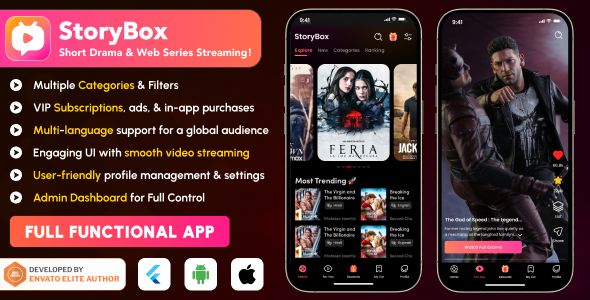
The short-form video market, once dominated by social media giants, is rapidly fragmenting into lucrative niches. The explosive popularity of platforms like ReelShort demonstrates a clear, monetizable demand for episodic, bite-sized drama. For developers and entrepreneurs watching this trend, the question isn't "if" but "how" to enter this space without spending a year and a six-figure budget on initial development. This is the exact problem that the StoryBox - Short Drama & Web Series Video Streaming Flutter App - Android, iOS, Web - Admin Panel aims to solve. It’s a full-package solution promising a fast track to launching a multi-platform video streaming service. But as any seasoned developer knows, "full-package" can mean anything from a well-oiled machine to a box of mismatched parts. This review isn't a sales pitch; it's a technical teardown from a senior developer's perspective. We'll dissect its architecture, walk through the entire installation process, and deliver a candid verdict on whether this is a solid foundation for your next big project or a technical dead end.
Part 1: Deconstructing the StoryBox Package
Before we get our hands dirty with code, let's understand what you're actually getting. StoryBox isn't just an app template; it's a two-part system designed to work in tandem: a client-facing front-end built with Flutter and a powerful back-end control center built on Laravel.
The Flutter Front-End: One Codebase, Three Platforms
The choice of Flutter for the client application is a strategic and, for the most part, intelligent one. For the uninitiated, Flutter is Google's UI toolkit for building natively compiled applications for mobile, web, and desktop from a single codebase.
The Good:
- Cross-Platform Consistency: The primary benefit is obvious. You write the code once, and it runs on Android, iOS, and as a web application. This drastically reduces development time and maintenance overhead compared to building and managing three separate native codebases. The UI/UX remains largely consistent across all platforms, which is a huge plus for branding.
- Performance: Flutter compiles to native ARM machine code, meaning it doesn't suffer the performance penalties of older cross-platform solutions that rely on web views or JavaScript bridges. For a video-centric app, where smooth scrolling and responsive UI are non-negotiable, this is critical.
- UI Customization: Flutter's widget-based system allows for deep and granular control over the user interface. While the default StoryBox UI is functional, a skilled Flutter developer can reskin the entire application to create a unique brand identity without fighting platform-specific layout constraints.
The Caveats:
- Web Performance: While Flutter for Web has improved immensely, it can still feel heavier than a traditional web application built with a framework like React or Vue.js. It loads a significant runtime engine (the "CanvasKit" renderer) which can impact initial page load times. For a content-heavy app like StoryBox, this is a trade-off to consider. It's excellent for providing a consistent app-like experience on the web, but it won't be the fastest-loading website on the block.
- Platform-Specific Nuances: While 95% of the code is shared, you'll still encounter platform-specific configurations, especially for things like push notifications, payment gateway SDKs, and hardware permissions. A "write once, run anywhere" promise always comes with an asterisk.
The Laravel Admin Panel: A Robust Foundation
The back-end is powered by Laravel, a mature and widely-respected PHP framework. This is an excellent choice. A poorly written, framework-less PHP backend is a common point of failure in many "all-in-one" scripts. Using Laravel signals a commitment to modern development practices.
Why this is a strong choice:
- MVC Architecture: Laravel enforces a Model-View-Controller pattern, which separates business logic from presentation. This makes the code organized, easier to understand, and far more maintainable in the long run. If you need to add custom features later, a developer won't have to spend weeks deciphering spaghetti code.
- Eloquent ORM: Interacting with the database is handled through Laravel's elegant object-relational mapper, Eloquent. This abstracts away raw SQL queries, reduces the risk of SQL injection, and makes database operations clean and readable.
- Security: Laravel comes with built-in protections against common web vulnerabilities like Cross-Site Scripting (XSS) and Cross-Site Request Forgery (CSRF). The API endpoints that the Flutter app consumes are likely built using Laravel Sanctum or Passport, providing secure, token-based authentication.
- Scalability Features: The framework has built-in support for job queues, caching (with drivers for Redis and Memcached), and file storage abstraction (which we'll discuss next). These are essential tools for scaling a high-traffic application.
Core Features and Monetization: A Critical Look
StoryBox comes equipped with the essential features for a video-on-demand (VOD) service:
- Content Management: The admin panel provides a straightforward interface for uploading videos, creating series, organizing them into categories, and adding metadata like titles, descriptions, and posters.
Monetization Engine: This is the heart of the business model. It supports two primary methods:
- Subscription Plans: Create different tiers (e.g., VIP, Prem

相关文章
热门文章

热门问题
等待解答
推荐专家